Most operational failures do not stem from bad decisions. They stem from processes that no one sees, no one measures, and no one is accountable for.
The Core Process
At Linfini, a B2B textile rental company, inventory management was deeply embedded in daily operations. Yet, the core process was largely maintained manually.
Stock levels were tracked manually, using a combination of spreadsheets, Word documents, and a physical blackboard in the warehouse. The team relied on this spreadsheet to know what was available, what was missing, and what needed to be restocked. This approach worked — until the logistical throughput became too significant.
Growth revealed complexity
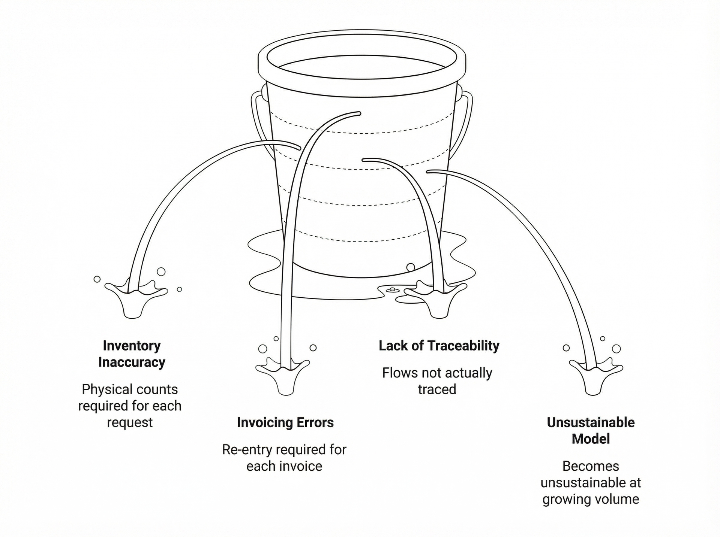
Manual tracking could no longer keep pace with operational reality. Discrepancies multiplied, visibility over stock deteriorated, and the accuracy of deliveries and billing became harder to guarantee.
The organization spent more time compensating for uncertainty than executing with confidence.
The goal was visibility
The project did not start with a desire to “transform” the organization. It started with a much simpler — and more critical — goal: Making reality visible within the system.
The objective was to ensure that every physical movement in the warehouse had a corresponding digital trace—without changing the way people actually worked.
What we deliberately chose not to do
Rather than redesigning processes, the approach focused on understanding them as they existed. Warehouse operations were observed on-site.
Existing habits were respected. The system was configured to reflect reality — not an idealized model.
• No heavy ERP overhaul
• No abstraction disconnected from daily operations
• No reliance on advanced technical expertise
The ambition was clarity.
When every physical movement creates a logical movement
Odoo was configured to reflect the actual flows of the warehouse: - Incoming goods immediately updated stock levels - Outgoing items were tracked at the point of dispatch - Inventory counts became continuous rather than episodic - Invoicing was directly connected to actual movements
The system ceased to be a reporting layer and became an operational backbone.
What changed...
Once visibility was restored, the impact was immediate:
- Easy and real-time stock tracking
- Automatic and accurate invoicing based on actual movements
• Elimination of manual reconciliation
• Ability to increase volumes without increasing overhead

The organization worked with less uncertainty.
Invisible processes are not harmless
They Are Costly. This case illustrates a pattern we regularly observe in growing organizations. The most dangerous processes are not those that fail loudly. They are those that operate silently, outside the system, until growth turns them into structural risks.
Visibility is not a reporting concern. It is a governance concern.
Listen Linfini story
Making the invisible visible
When critical processes rely on memory, spreadsheets, or manual compensation, the risk is already present—even if the results still seem acceptable.
If this situation sounds familiar, it usually means that some of your most important processes are invisible. A short diagnostic conversation is often enough to make them visible.
Contact us today to discover
how to unlock your full growth potential:
Contact Us Now Book a Free Quick Scan